

If the last decade has taught us anything, it’s that culture, burnout and subtle disengagement don’t wait for big resignations to do damage. What’s striking now is how the latest workplace discourse is less about dramatic exit and more about slow erosion and silent resistance – and we can see it play out in social trends and buzzwords across TikTok and LinkedIn.
Here’s a snapshot of the latest and why they matter for businesses right now.
What the buzzwords mean
Below is a brief glossary and commentary on some of the most talked-about workplace trends today. They’re not always sharply delineated from each other, but thinking through their nuance helps leaders see what’s happening beneath the surface.
(click/tap to enlarge)
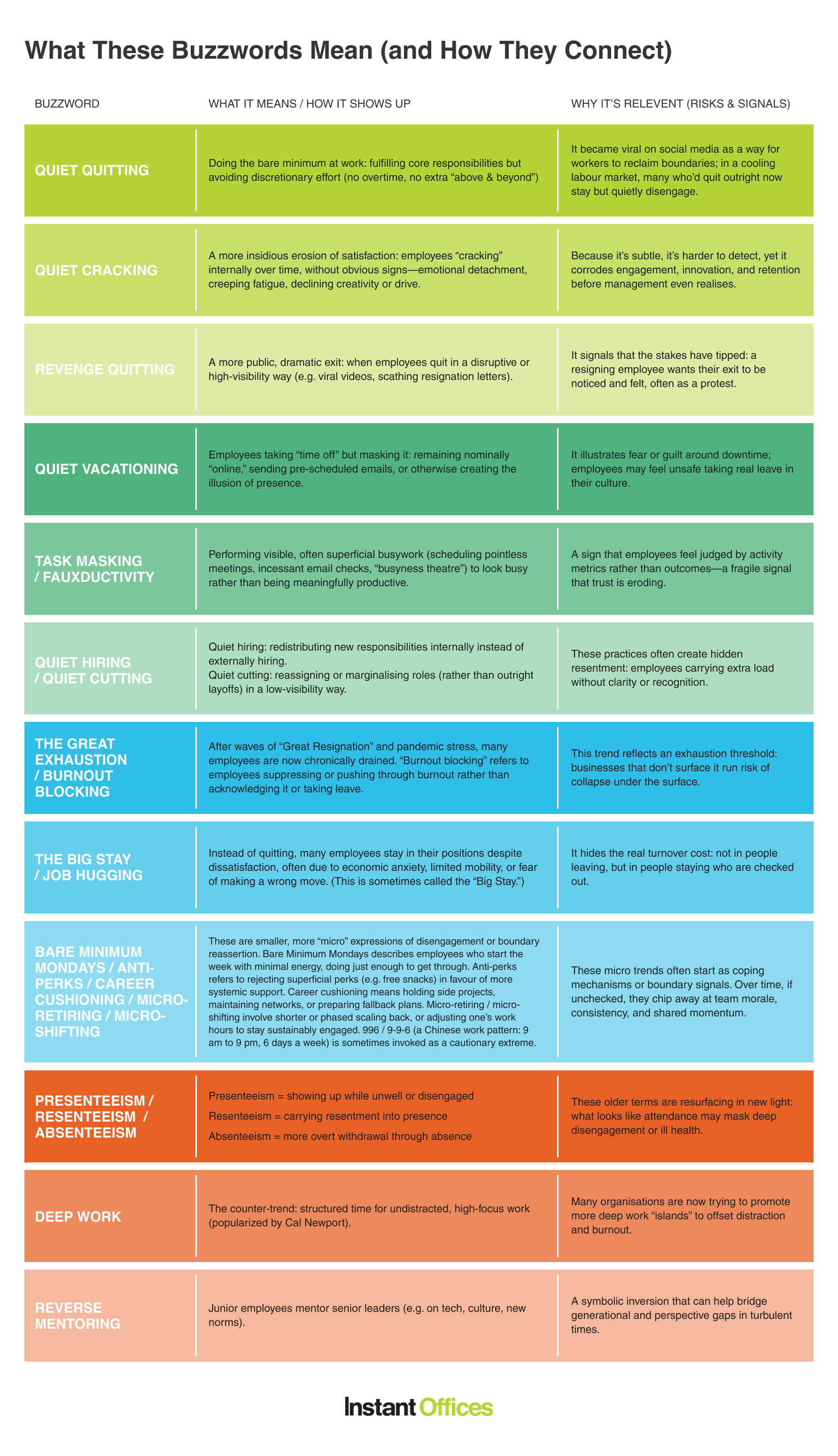
Why these trends matter
Economic uncertainty and a less forgiving labour market
As markets cool and job mobility shrinks, many employees feel stuck. Instead of quitting, they quietly shift into disengaged mode. This helps explain the rise of quiet staying/job-hugging tactics.
Burnout fatigue meets boundary pushback
After years of pushing through, many workers refuse to “go above and beyond”, thus quiet quitting, bare minimum Mondays, or burnout blocking.
A shift from ‘exit’ to ‘silent sabotage’
Mass resignations had clear visibility. Today, much of the damage is happening inside: in the checked-out people who are still holding seats.
Trust, metrics, and the invisibility trap
When organisations continue to reward visible motion rather than meaningful output, they train behaviours like task masking and fauxductivity.
Rising mental health and wellbeing pressures
Surveys in the UK show that burnout risk remains high, with generational divides emerging in stress and pressure levels. In addition, sectors that once led in wellbeing (tech, professional services) now report declines.
Read: The most burnt-out cities in the world
Search & signal: rising public awareness
Employees are actively Googling terms like “quiet cracking”. Searches are up 1,085% over the past quarter. This suggests not just internal rumblings, but that people are actively seeking language for what they feel.
How businesses can spot & respond to these trends
It’s not enough to call these buzzwords “interesting.” Businesses should treat them as early warning signs and act before disengagement becomes attrition. Below are principles, signals to watch for, and practical steps.
Signals and signs to watch out for
- Discrepancy between output and energy: teams deliver but seem constantly tired or flat.
- Rising “quiet indicators”: e.g. declines in idea contributions, passive compliance and less cross-collaboration.
- “Busy but hollow” behaviour: lots of movement, low impact (task masking).
- Employee chatter: if people begin Googling “quiet cracking” or discussing burnout themes internally, that’s a red flag.
- Leave patterns / sick days/lateness spikes: in clusters or among high performers.
- Side hustles, network activity, external job exploration (career cushioning): these are early hints that people are hedging.
- Manager feedback gaps: teams reporting that they don’t feel listened to, or that nothing changes.
Ways to respond
Normalise conversations early
Make space for the small cracks before they become seismic. Encourage check-ins, not just documentation of KPIs, but check-ins about wellbeing and friction.
Shift from input to outcome metrics
Measure results, not motion. Reward impact, not busyness. This eases the pressure to over-perform visibly or do ‘fake work’.
Embed psychological safety & voice mechanisms
If people fear pushback or dismissal, they’ll likely internalise rather than communicate. Anonymous surveys, forums or structured upward feedback can break the silence.
Design repairable systems, not just motivational efforts
Carrot-and-stick won’t cut it. Address role clarity, workload balance, process improvement, and resource mismatch (i.e. structural stressors, not just motivation).
Support micro-resets and recovery rituals
Allow buffers, mini sabbaticals, deep work days, or mental health breaks. Encourage leave usage rather than quiet vacationing.
Train managers to read emotional cues
Managers often miss quiet cracking because it doesn’t crash loudly. Equip them to notice subtle disengagement: tone shifts, reduced questions or boldness, downward spirals in initiative.
Elevate cross-mentoring and reverse mentoring
Encourage junior-to-senior conversations to surface changing expectations, new pressures, and generational lens shifts.
Be willing to experiment, iterate, and course-correct
Treat wellbeing/sustainability initiatives as living experiments. Solicit feedback, iterate, and evolve rather than treating it as a one-off program.
Transparency and story sharing
Share what you’re learning (where you’re failing, where you commit to improve). Vulnerability from leadership diffuses defensiveness and builds trust.
Looking for Office Space?
We Operate in Some of the World’s Top Cities:
London, New York, San Francisco, Paris, Singapore, Hong Kong, Search more locations