
Did you know that 45% of companies are planning to restructure in 2021? While the COVID-19 pandemic felt like it was slowing down progress in the business world in many ways, it has actually accelerated several key developments in the workplace, which would have taken much longer without the unexpected disruption.
Policies on a national and company level have shifted to focus more on talent investment, helping more workers to keep their jobs for the duration of the pandemic and beyond.
Investment in Retaining Talent During 2020
Various countries adopted temporary policies to help protect the jobs and incomes of the population by incentivising employers to retain their workers despite the financial challenges of 2020.
Wage subsidies:
The UK, Ireland, Australia and Canada all introduced a new wage subsidy scheme during this time. Meanwhile, countries around the EU adapted their pre-existing schemes. The US doesn’t have an explicit wage subsidy scheme but offers multiple other schemes that encourage businesses to continue employing their staff.
The UK offered a maximum payment of £580 per employee per week via wage subsidies. Ireland provided £360 per week, while Australia paid the equivalent of £410 and Canada £500 per week.
Unemployment benefits:
Many countries also introduced temporary benefit programs or increased the generosity of existing unemployment benefits for those unable to work. For some countries, this was an entirely new benefit. For those with an initial offering in place, the UK provided claimants with an extra £20 per week, Australia paid £150 extra per week, and the US paid an extra $600 per week.
Work from home allowance:
With the sharp rise in remote working during the pandemic, more workplaces are also being encouraged to cover employees for expenses incurred while working at home (such as electricity or laptop repairs).
Better Investment in Employees is a Top Trend for 2021
As the new world of work takes shape, one of the top talent trends that emerged for 2021 has been a drive to reskill and upskill employees. Companies around the globe are focusing on ways to invest in their talent.
According to a McKinsey survey, 69% of respondents say they have seen an increase in skill-building during the pandemic, and 58% say that closing skill gaps has become a higher priority for their companies since it started. However, skill-building as a strategy is outstripping other key methods of closing skill gaps, such as hiring, contracting, redeploying and releasing.
Upskilling Spend: APAC Leads the Way
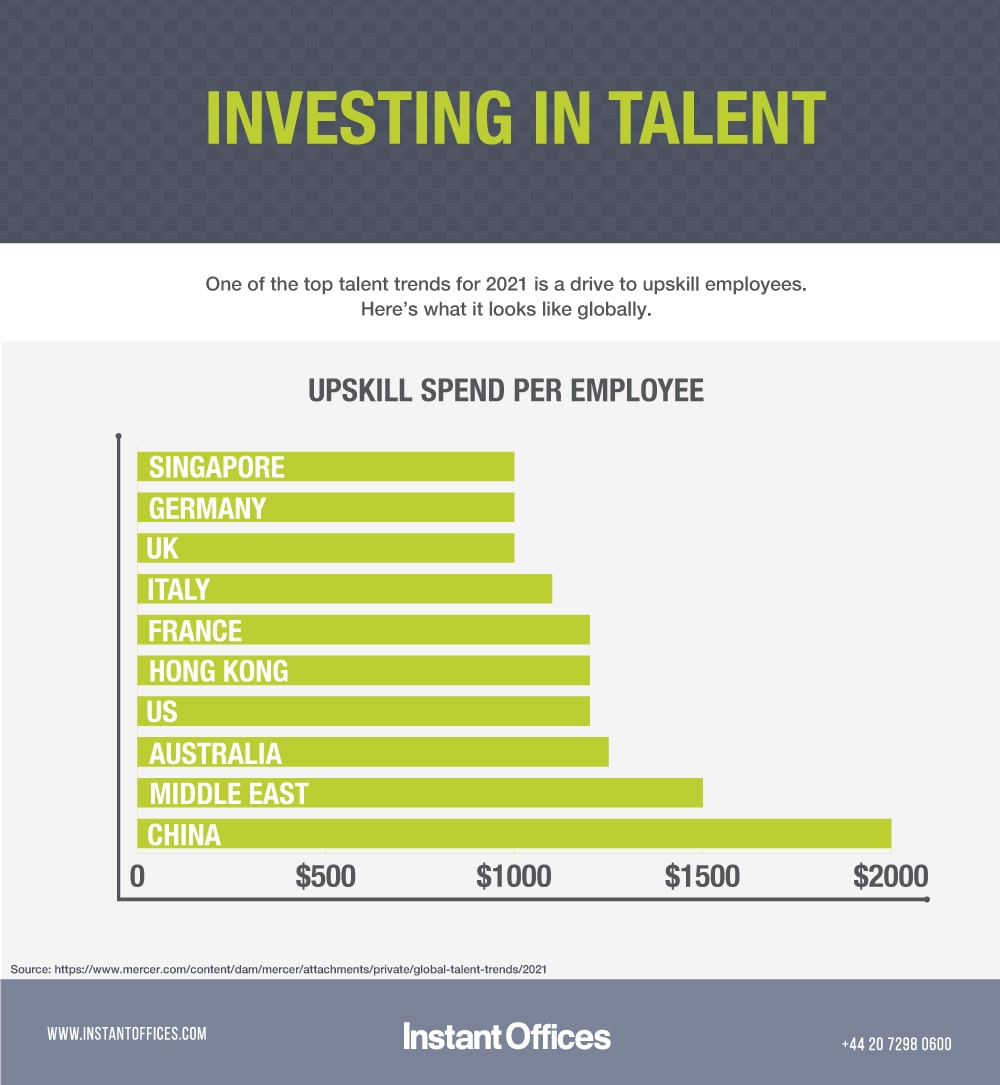
The following countries have seen a significant projected year-on-year increase in upskilling and reskilling spend per employee:
- China: $2000
- Middle East: $1500
- Australia: $1250
- United States: $1200
- Hong Kong: $1200
- France: $1200
- Italy: $1100
- United Kingdom: $1000
- Germany: $1000
- Singapore: $1000
This list is dominated by countries in the APAC region, which China, Australia and Hong Kong all in the top 5.
Which Skills are Companies Prioritising?
There has been a growing demand for “softer” social and emotional skills in the workplace and advanced cognitive skills.
The skills currently taking top priority when it comes to reskilling employees (i.e. those which have seen the biggest year-on-year increase) are:
- Interpersonal skills and empathy
- Project management
- Leadership and managing others
- Basic digital skills
- Adaptability and continuous learning
- Quantitative and statistical skills
- Critical thinking and decision-making
Experts predict that to succeed in the new world of work, companies will need to place empathy at the heart of their operations. Nearly 2 in 3 employees were already heading for burnout before the start of the pandemic, which clearly shows that going “back to normal” won’t be sustainable in a post-pandemic world.
Investment in Mental and Emotional Health
With the growing need for empathy in mind, more companies say they plan to promote long-term health goals for their employees in the future. The most popular strategies are:
- Add benefits to address mental or emotional health issues: 47%
- Enable remote and digital health-check services: 36%
- Include a mental or emotional wellbeing strategy: 33%
- Add services to address physical health issues: 29%
- Train managers to notice signs of mental health issues: 29%
As some employees try to cope with the anxiety of returning to work and others continue to navigate the emotional challenges of working remotely, more companies must start seriously investing in the wellbeing of their people.
Looking for Office Space?
We Operate in Some of the World’s Top Cities:
London, New York, San Francisco, Paris, Singapore, Hong Kong,
Search more locations